The Emergency Manual Switching System was designed to provide a skeleton long distance telephone service for Civil Defence, Military and Emergency Services should the normal public switched network be affected by enemy action. The system was closed at the end of the cold war in the early 1990s.
The GPO / BT had its own network of circuits that would be used to coordinate security and maintenance of the public network in an emergency. Often this network shared the same EMSS switchboards, it is important enough to have its own "GPO / BT War Organisation" Chapter on this website.
Emergency Manual Switching System (EMSS) Overview
Before the mid-seventies, long distance calls were connected via manual switchboards located in buildings known as the Auto Manual Centre (AMC) containing the main switching centre for a group of exchanges. The Emergency Manual Switching System (EMSS) consisted of a network of 300 manually operated switchboards situated in the basement protected area in an AMC building. They were sited here as they needed to be operated by trained personnel who would normally staff the public switchboard. There was an option to handle the EMSS calls on the 'Normal' peacetime switchboard or divert them to the basement, depending on the conditions prevailing at the time.
In the Post-Strike phase of a nuclear war the EMSS would operate from the switchboard in the basement of the exchange building, providing telephone service to essential users during the recovery phase or it may be used during the transition to war, if normal telephone service were suspended or restricted by the Telephone Preference Service (TPS) described elsewhere on this website. The number of protected switchboard positions provided depended on the estimated privileged traffic through that exchange.
In addition to the switchboard itself, racks of relays and other equipment are needed to make it function, these may be housed in the switchboard room, but at larger sites in a nearby basement room. Staff welfare rooms adjacent to the switchboard contain bunk beds, basic toilet and washing facilities. Food ration boxes were stored on site for those staffing the switchboards and engineering support. Further details in the section G.P.O. / BT War Organisation linked from the bottom of this page and in the Chapter Index.
EMSS Network Structure
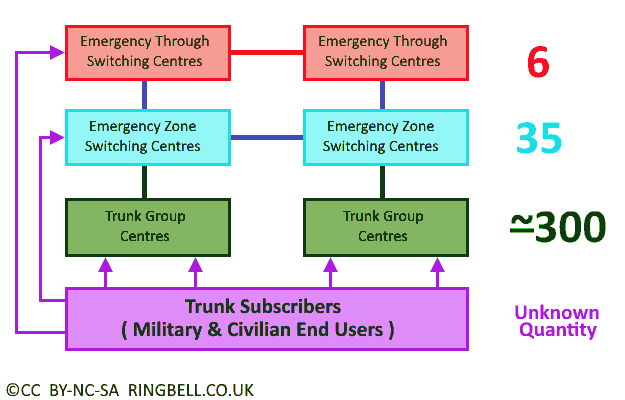
The EMSS network is built in three levels, the top tier comprises of six Emergency Through Switching Centres (ETSC) all fully interconnected. These handle long distance calls passed up from the tier below.
The second tier has thirty five Emergency Zone Centres (EZC) Each is connected to at least two ETSC switchboards in tier 1 above and has sideways routes to one or more nearby Tier 2 EZC.
There were around 300 Tier 3 Trunk Group Centres (TGC) but only a third have been positively identified so far. The TGC usually have two links upwards mainly to Tier 2 EZC but in some cases to a Tier 1 ETSC. The Tier 3 TGC do not have sideways routes to other TGC so calls between switchboards in the next town down the road will go via a Tier 2 or Tier 1 switchboard. The majority of Trunk Subscribers (Tk Sub) are connected to Tier 3 TGC switchboards as indicated below.
EMSS Structure
I am most grateful to Dave McKay G1JWG who forwarded an Annex to a National Archives File HO322/824 entitled Machinery of Government in War Communications Working Party, which he recognised was a sketch of the whole EMSS Network, saying that it appeared to be an orphan unrelated to the rest of the file. This chance discovery has enabled me to create the network diagrams shown in the gallery below.
Diagrams of the National EMSS Network$
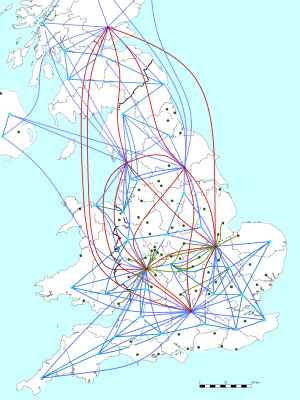
Using the PRO file HO322/1220 it is possible to identify one hundred out of three hundred nodes in the network, the others have been discovered by chance. Network Gallery Image 1 shows the sites that have been discovered to date just around a third of the total deployed. Due to the lack of data, Network Gallery Image 6, shows just a few of the thousands of routes that must have existed connecting Tier 3 TGCs in their EZC and in some cases ETSC.
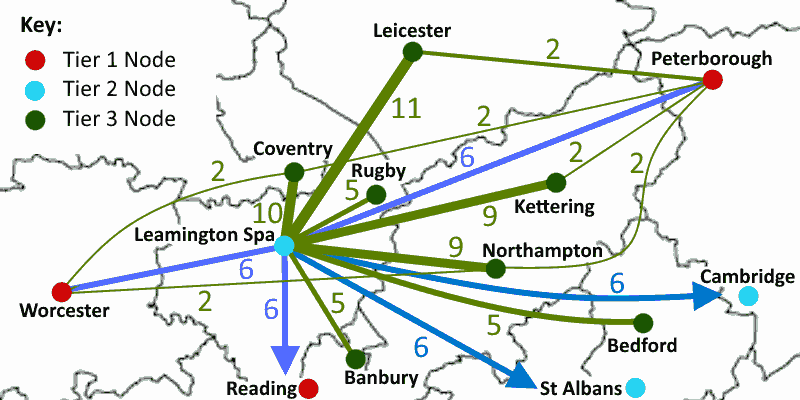
The diagram below shows the routes between Leamington Spa Tier 2 EZC and its seven dependent Tier 3 TGC switchboards and the number of circuits in each route. Leamington has three routes to Tier 1 ETSC switchboards and two routes to other EZC switchboards. Some of the Tier 3 nodes have small routes to Tier 1 ETSC Nodes.
Bottom Tier of EMSS showing routes and circuit quantities
The routing of EMSS telephone traffic is very different from that in peacetime. Note that none of the Tier 3 EMSS Nodes are interconnected but that wasn't the case in peacetime. Kettering in the centre of the map had direct routes to Bedford (26), Cambridge(60), Northampton(95) and Leicester (273) the 1971 circuit quantities shown in brackets. Additionally having routes to the cities of Birmingham (74), Leeds (24) and London (156). By comparison the EMSS network was only designed to handle a small number of calls from its few special customers. Although Kettering had peacetime circuits directly connecting it to Bedford, Leicester and Northampton, all EMSS calls would have to pass via Leamington Spa.
Many of the routes between EMSS centres used exclusive circuits, not carrying normal public telephone traffic. Some routes had non-exclusive circuits too. These usually carried public traffic, but for testing, defence exercises or a war emergency, they could be switched from the normal automatic telephone exchange over to the EMSS network.
Trunk Subscribers ( Tk Sub ), the end users of the EMSS network are connected to all three tiers of the network. Some important establishments had two EMSS circuits connected to two different switchboard sites for added security.
There were minor changes during the life of the EMSS network, Carmarthen is shown on the map as a Tier 2 node but the basement flooded in 1984 and the EMSS was closed, it may have been replaced by another switching centre or amalgamated into Merthyr Tydfil. The Tier 2 node at Salisbury was replaced by Bournemouth for some reason yet to be discovered.
Non Trunk Sub Access to EMSS
Calls could be connected across the whole country by only using the EMSS network. But in order to connect calls to people and organisations not directly connected to EMSS, circuits were also provided outward into the normal public network. At Worcester, a group of 10 outgoing lines gave access to local area customers and a further 10 outgoing lines for National Number Dialling. Similar arrangements were replicated at most EMSS switchboards.
A number of Priority Answer (PRT) circuits were provided to allow privileged users who didn't warrant a Trunk Subscriber circuit or didn't work from a fixed point to use EMSS. The privileged user had to find a working phone and dial a special number. These PRT lines may be either a PBX number where one number has a number of lines. Later the code 198 could be dialled by PRT users. Three way switches in the EMSS room allowed PRT numbers to call on the normal peacetime above ground switchboard, the basement EMSS or to be connected to Number Unobtainable Tone.
Terrorist Threat
During the period of troubles in Northern Ireland, telephone exchanges in the province and UK mainland became bombing targets. Many hoax bomb threats were made too, necessitating the evacuation of the exchange building. Special arrangements were put in place to transfer 999 calls to another town. When small single position EMSS were modernised to a suite of switchboards, provision was made for a small quantity of Operator Assistance 100 and Emergency 999 circuits to be answered in the basement if it was necessary to stop using the normal operator switchboard.
EMSS Switchboards in Protected Accommodation
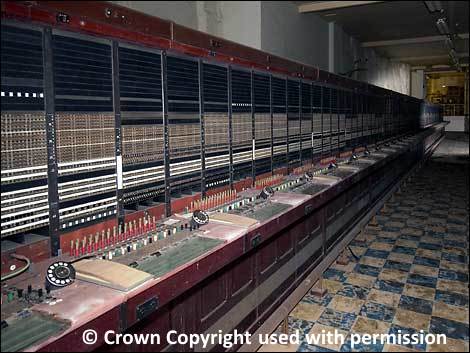
Worcester EMSS featured in the gallery was one of only six large Emergency Through Switching Centres (ETSC) in the U.K.
Gallery of EMSS Switchboard at Worcester$
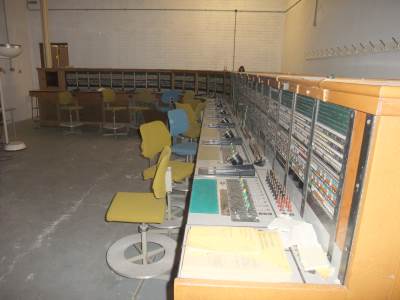
In the Worcester switchroom there are 12 switchboard positions. All the incoming and outgoing lines are repeated along the length of the switchboard suite so that all are within easy reach of all the operators. There are two and a half faces per switchboard. The lower part of the face, the answering section contains the incoming circuits, these repeat themselves every six faces, A0 - A5. The outgoing lines in the upper section of the face repeat every four faces J0 - J3.
Each operator position has fourteen pairs of plug ended cords, as seen in gallery image 3, limiting the number of simultaneous calls one operator can connect to that number. Unlike their public switchboard counterparts, the cord pairs do not have a time clock associated with them as calls are not charged. The operator answers an incoming call with an answering plug, which is in the row nearest to the switchboard face. The calling plug of the pair (row nearest to the operator) is placed into the appropriate outgoing line in the top section of the switchboard face.
Within the switchroom is a test jack frame shown in gallery image 7. Its purpose here is to switch the circuits from the normal peacetime switchboard to the apparatus room within the protected accommodation. Operating staff can switch from the normal switchboard to the emergency switchboard by moving the red plugs up from the 'S' row where they are currently situated to the 'N' row above. The third 'M' row is for monitoring and test purposes.
The gallery images 9, 10 & 11 show the apparatus room next to the switchboard room. The relaysets convert the signalling conditions sent down the external lines to those needed by the switchboard. Due to the importance of the Worcester EMSS as just one of six main centres, it has its own set of batteries and standby generator independent of the exchange's own batteries and generators.
Through Group Centre
The Through Group Centre (TGC) is the bottom tier of the EMSS network and normally has two groups of circuits connecting to higher levels, but never any interconnection to nearby TGC. They are not expected to handle a large number of calls, so require fewer switchboard positions than in the Worcester example.
Through Group Centres$
Some TGC may also double up as BT Defence Network switchboards. This separate network is described in a chapter dedicated to the G.P.O. / BT War Organisation linked from the bottom of this page and in the Chapter Index in the bar at the top of every page.
The Trunk Subscriber
A special type of customer's line existed well before the Cold War period and continued until the telephone network became digital. These customer lines terminated directly on the GPO public switchboard and were known as 'Trunk Subs' deriving their name from Trunk Exchange and Subscribers (the old name for customers). Typical customers would be the Police, Fire and Ambulance control centres dealing with 999 calls. When someone dialled 999 and asked the GPO operator for the Police, to save the time it would take to dial the control room's telephone number, the operator can plug into the Trunk Sub and be directly through to the Police control centre.
Trunk Sub lines could also make calls, if they picked up their telephone, or plugged into it on their private switchboard, it called the GPO switchboard and was immediately answered by the operator.
Additionally in the cold war period, a variety of privileged customers were connected as Trunk Subs. Military Establishments such as Armed Forces HQ (AFHQ). The U.K.W.M.O. Group controls. BBC control centres and transmitter sites. Local Authority Emergency Centres (LAEC) and Regional Government Headquarters (RGHQ) were typical users. This gave these priority access to the GPO switchboard operators and were not reliant on the automatic network. There were other civilian uses for Trunk Subs such as special phones at exhibitions, or to the Queen's train making an overnight stop in a siding.
Trunk Subs at Worcester consisted of the Blue Light service, Police Tk Sub 1, Fire Tk Sub 8 and Ambulance Tk Sub 5. Additionally for local government Tk Sub 20; Worcester County Hall (Local Authority Emergency Centre) and Tk Sub 32; the Regional Government HQ - RGHQ 9.2 at Drakelow Tunnels, Kinver. Also a few others to the County Showground at Malvern, for the GPO telephone caravans that attended such events.
During a war situation, the Trunk Subs would be diverted into the basement EMSS switchboard, allowing them to have a rudimentary telephone service. The public automatic system in that era was designed to connect calls via a predetermined fixed route, if that route was damaged, the calls would fail. Manually connected calls have the advantage of being able to find an dynamic alternative route around the damage.
These privileged users were given an anonymous Trunk Sub number. This meant that GPO operators never needed to know the identity of the Trunk Sub, as incoming callers would just ask for a Trunk Sub number in a certain town. For example, Mytown Trunk Sub 11 would ask for 'Anytown Trunk Sub 9'. The call would pass through the GPO network from 'Mytown' until the 'Anytown' operator connected the call to its Trunk Sub 9. None of the operators along the route needed to know the identity of the caller or called line.
UKWMO Group Controls on EMSS
Declassified documents in the Public Records Office (PRO), reveal that all ROC Group and Sector Controls in the UKWMO were connected as Trunk Subscribers into the EMSS Network in 1972.
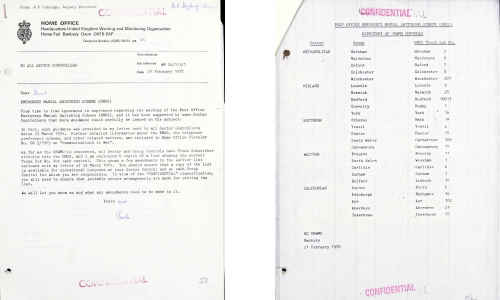
Due to the "Confidential" security classification of the EMSS, little was known about the system by its potential users, the PRO file HO332/1220 shows this was of concern to the Civil Defence College at Easingwold as it inhibited the subject being included in their training courses. This concern is reflected in a letter to Sectors dated February 1978 from Mr R F Cumings, Deputy Director of the UKWMO. From time to time ignorance is expressed regarding the working of the Post Office Emergency Manual Switching System . . . the full letter is reproduced below.
UKWMO Letter to Group Controls$
It is essential that EMSS users know the relevant Trunk Sub numbers of those they wish to connect to. As stated in the Trunk Subscriber topic above, the GPO operator did not know the identity of the called line, the caller just quoted an exchange and Tk Sub number. It wasn't possible to ask the operator for example "Coventry UKWMO Group" as she would have no way in knowing this was Tk.Sub No.1 on Rugby exchange.
Central Government War Headquarters at Corsham
Woodland Switchboard at Corsham
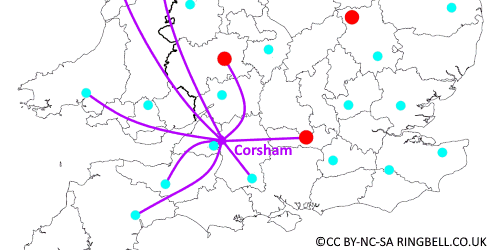
Declassified documents relating to the Central Government War Headquarters (CGWHQ) at Corsham, reveal that in 1968 Woodland Exchange had a total of 37 lines to EMSS switchboards around the country. The map shows the nine E.M.S.S. locations connected to CGWHQ, four are Tier 1 ETSC centres and five are Tier 2 EZC.
EMSS Network to Corsham CGWHQ
Circuits from Corsham to EMSS Centres
EMSS Location
Circuits
EMSS Location
Circuits
Reading ETSC
10
Carmarthen EZC
2
Worcester ETSC
10
Exeter EZC
2
Bath EZC
3
Lancaster ETSC
2
Salisbury EZC
3
Perth ETSC
2
Taunton EZC
3
As a former GPO / BT engineer, I was puzzled how such a large communications centre could be hidden in the network. In recent years the archives reveal that most of this network was in the open to anyone who knew the code - the clever bit was that we didn't. The code was cleverly chosen so as not to look any different from any other military or government location that GPO/BT people were used to seeing, therefore not raising any suspicions.
Telephone Exchanges and Repeater Stations are identified by an Engineering Code, known as the THQ1141 code consisting of two or three letter codes. GPO Radio Microwave stations have a four letter code beginning with 'Y' and this was extended to include customers premises renting private wires (PW) also known as private circuits. These THQ1141 codes were published openly throughout the organisation.
A series of 1141 codes having four letters starting with 'Q' were reserved for use at Government and Military establishments. However, these were controlled by Telephone Headquarters (THQ) and only released on a need to know basis. Once the CGWHQ was declassified and photographs of the telephone apparatus appeared on the Internet, it became apparent the 1141 code was 'QQCF'. The military South West Communications Centre (SWCC) with the code 'QQCC' is underground in quarries next door to the CGWHQ, the archives show that many potential parts of the CGWHQ network terminate at the military communications centre in peacetime and could be extended through should the CGWHQ bunker need to be brought into use.
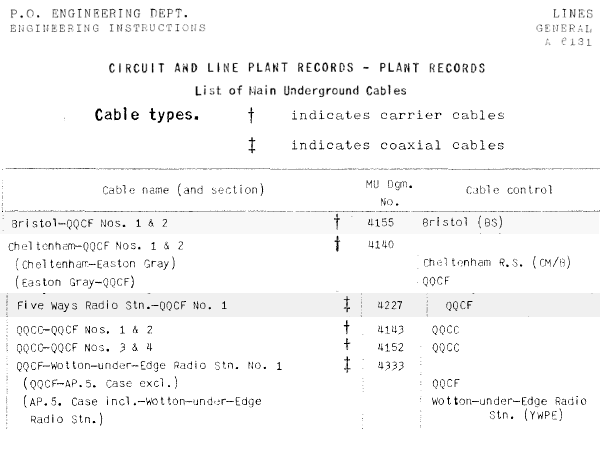
Lines, General A6131 Extract [1966]
The THG Archives hold a document, a P.O. Engineering Instruction: Lines, General A6131. A copy of this 58 Page document must have been distributed to hundreds if not thousands of GPO sites throughout the country, it was certainly not a secret document, giving a list of main underground cables and their maintenance control. This 1966 copy is Issue 14, regular updates would be issued when necessary.
Armed with the THQ 1141 Code for the CGWHQ and SWCC, we can find a number of entries, representing direct cables. Additionally other cables may pass through CGWHQ en route between cities.
Direct cables to QQCF radiate out to: Five Ways microwave radio station 'YCSM', South West Communications Centre 'QQCC', Bristol 'BS', Wotton under Edge microwave radio station 'YWPE' and Cheltenham telephone repeater station 'CM/B'
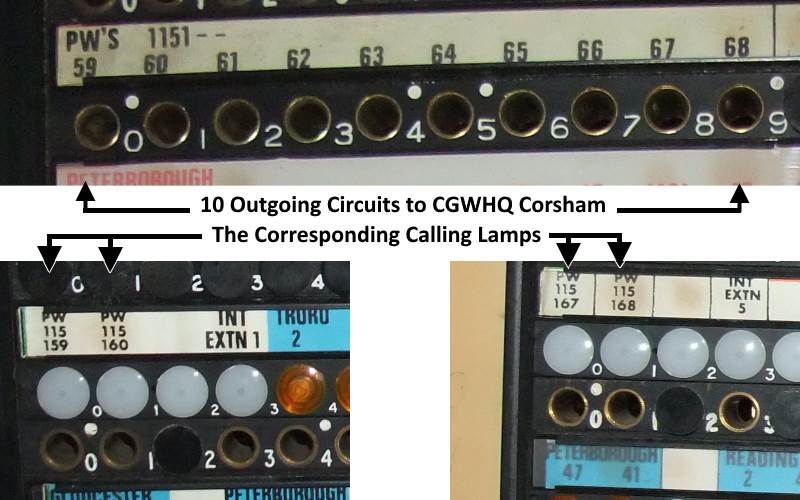
How could the bunker at Corsham be disguised at the EMSS switchboards, where routes to other towns are printed on the switchboard label?. I had expected it might simply have a Trunk Sub number at each of the interconnecting EMSS but these would normally be single circuits not a group of them. At Worcester, there didn't appear to be a group of 10 Trunk Subs for Woodland and the name Woodland didn't appear anywhere. However on the face of the switchboard there are a series of 10 outgoing jacks marked as 'PW1151--' and each jack has an individual number. These numbers correspond with the 10 incoming jacks and calling lamps, marked PW115159 to PW115168. A Telecommunications Instruction in the BT Archives reveals that during the transition to war period, the peacetime 'PW Number' labels will be replaced with something more pertinent.
Telecommunications Instruction A9 A0381 Para 3.5 contains the following text . . . an additional label, showing the circuit designation only, is required, which should be inserted in the switchboard. The "name" labels should be held in a suitable security container.
Central Government War Headquarters EMSS Lines
Closure of EMSS
Cabinet Papers from 10th June 1993, held in the National Archives at Kew, give a closure date. This decision was prompted by the Government Review of Emergency Communications (GREC) report. The papers are mainly concerned with the government 'Emergency Communications Network' ECN, but have many references to EMSS.
CAB 134 / 5766 extract . . . [11] The GREC recommended that subscribers to the obsolescent EMSS network, which had been maintained by BT in order to serve the wartime communications needs of central government, should be connected to the enhanced ECN. The EMSS was accordingly withdrawn, in stages, from 1991, and finally closed in February 1992, before which date all subscribers who had confirmed the need for access to an emergency network had been transferred onto the ECN.


 The Images from BT Archives are Copyright BT Heritage, licensed under a